
From my experience, Vaadin has always stood out from other Java frameworks. Of course, it enables the creation of modern web UIs, but the real difference lies in its component architecture. This is not conceived as a short-term aid, but is consistently designed for maintainability and flexibility. It creates the possibility of running applications stably for many years while still being able to extend them step by step.
Whether I use a component from the official library, develop my own, or integrate an npm package, Vaadin ensures that all building blocks follow a clear pattern. The connection between server and client remains consistent and reliable. This has allowed me to further develop applications over time without ever being forced to rebuild them entirely from scratch.
Note: This post builds on and reflects further upon the excellent original article by Sami Ekblad, who provided a concise overview of what makes Vaadin components special. My intention here is to expand on those ideas with reflections from my own long-term use in practice. -https://dev.to/samiekblad/what-makes-vaadin-components-special-9oo-temp-slug-1862339
More Than Just UI Widgets
In my practical work, I have observed that libraries such as React or Lit understand their components primarily as frontend building blocks. Vaadin deliberately takes a different approach. For me, the focus is on longevity and extensibility , which are crucial in long-term projects. I have seen applications operated with Vaadin for more than a decade, and the underlying component architecture is designed precisely for this.
What I find particularly interesting is the possibility of implementing UI components either entirely server-side, purely client-side, or in a hybrid form. This freedom of choice is the real strength that sets Vaadin apart from traditional UI libraries and gives me the flexibility to choose the most appropriate solution for each use case.
Three Approaches to Vaadin Components
1. Server-Side Components
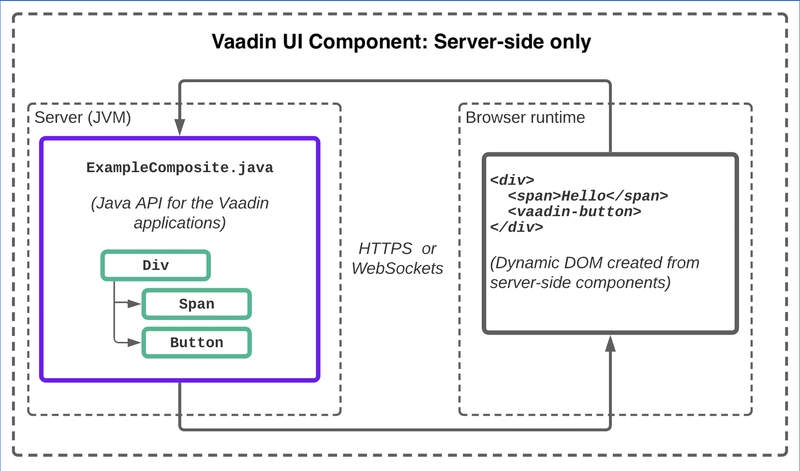
This is the most traditional route: development is done exclusively in Java. HTML templates or JavaScript are not necessary. With existing building blocks such as TextField, Button, or Grid, entire interfaces can be assembled. These can, in turn, evolve into higher-level components, such as an InvoiceEditor that directly integrates business logic and input validation.
Strengths:
Server-side components offer maximum control over the validation and security of user input, as all checks take place directly on the server and are thus protected against manipulation. At the same time, there is no dependency on frontend technologies, which reduces complexity and simplifies maintenance. Another advantage is the possibility of generating user interfaces dynamically at runtime, allowing flexible responses to changes in business logic or context. In addition, existing Java libraries and enterprise logic can be integrated seamlessly, creating a smooth transition between UI and backend.
Weaknesses:
Every user interaction requires a request to the server, which in scenarios with very high interactivity can lead to noticeable delays. In particular, with animations or complex drag-and-drop mechanisms, this approach reaches its limits, as such functions demand an immediate response in the browser that cannot be achieved without client-side logic.
2. Client-Server Components
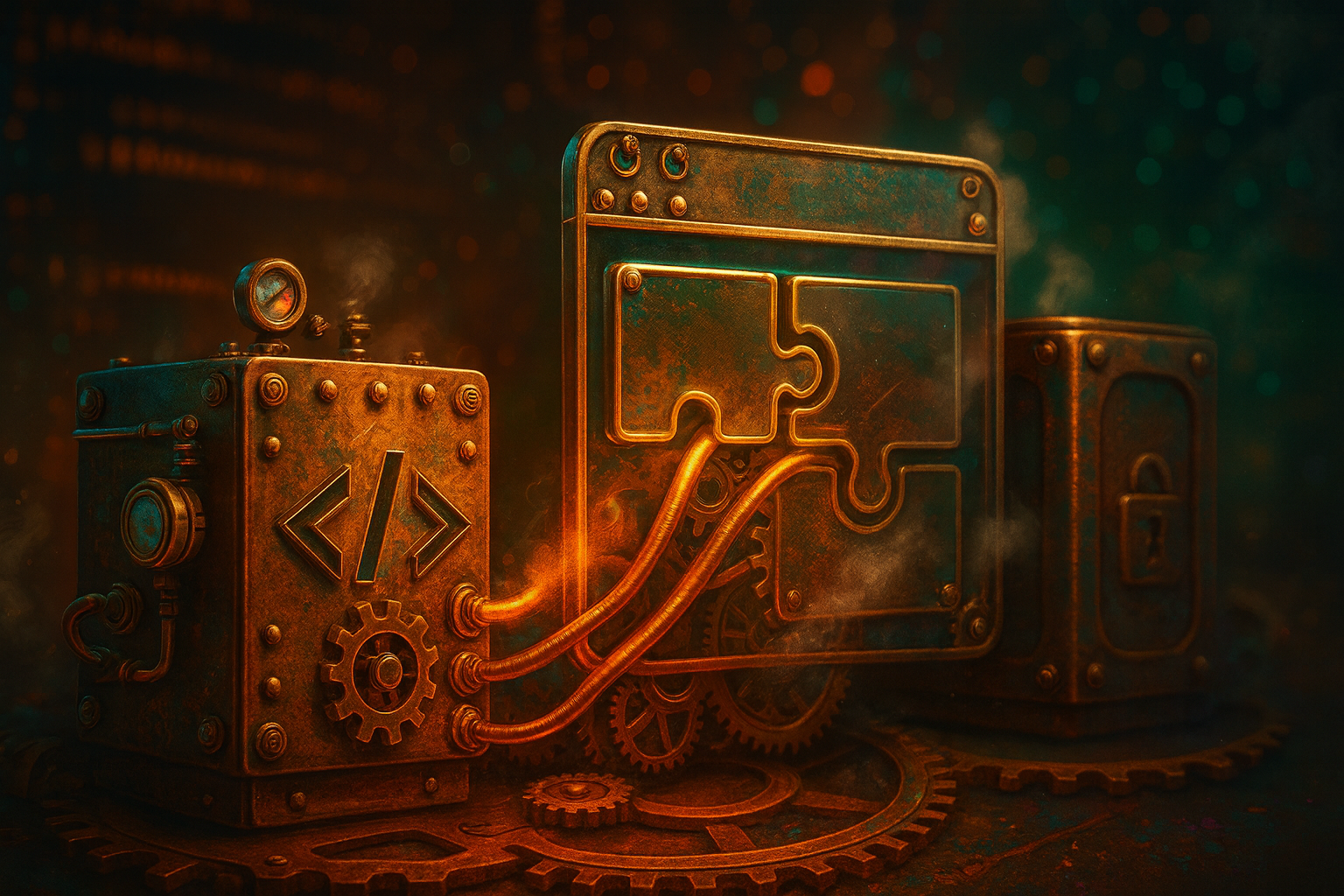
Here, client-side web components (Lit, TypeScript, or Vanilla) are combined with a Vaadin Java API. This architecture unites a rich user experience with secure backend validation.
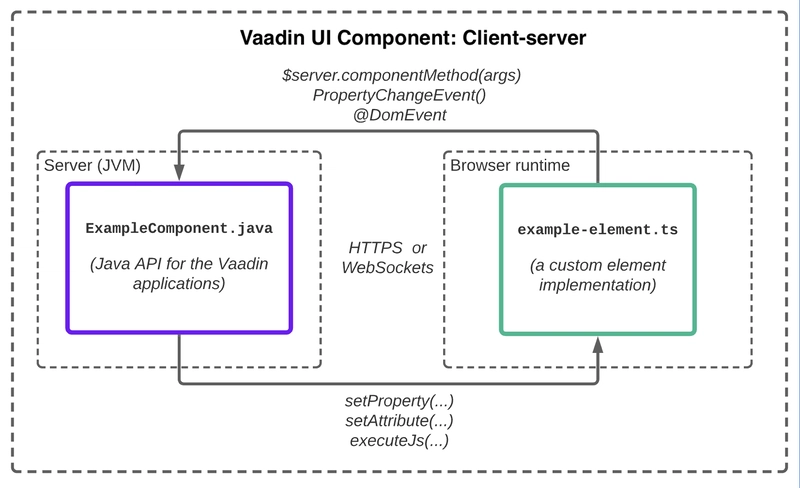
Example: A date picker with keyboard shortcuts, colour transitions and smooth animations, while still ensuring that inputs are reliably validated on the server.
Strengths:
Client-server components provide complete control over the DOM and all interactions in the browser. This makes it possible to realise complex and responsive user interfaces that keep pace with modern web standards. At the same time, business logic does not remain unprotected in the frontend but is validated and executed server-side in Java, ensuring a high level of security. Another benefit is the clear separation between UI and server logic, since communication is handled in a structured way by the framework, promoting clarity and maintainability.
Weaknesses:
A disadvantage is that developers need solid knowledge of both Java and TypeScript. This dual requirement can raise the entry barrier and lengthen the learning curve, since one must be familiar not only with server-side concepts but also with the particularities of client-side development. Especially in teams that have so far focused predominantly on one language, this can demand additional training and a more intensive onboarding process.
3. Integration of Third-Party Components
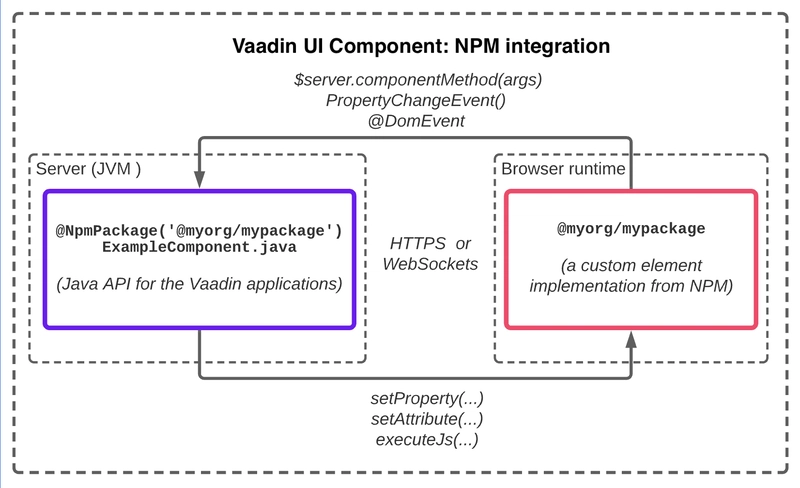
The modern web is rich in high-quality custom elements available via npm. With Vaadin, these elements can be easily integrated into an application. A small amount of TypeScript is sufficient to build the bridge to the Java world.
Strengths:
The integration of existing web components is particularly fast and straightforward, since ready-made elements from the npm ecosystem can be included with minimal effort. Developers benefit from the fact that only a small amount of boilerplate code is required to make a component usable. This leaves more scope for actual application logic. These integrated elements are also well-suited for visual enhancements or additional convenience features that may not be business-critical but still improve the user experience noticeably.
Weaknesses:
One drawback of integrating third-party components is that server-side validation is not automatically provided and must instead be implemented individually. Developers, therefore, need to add backend logic to ensure that inputs are reliably checked and possible manipulation is prevented. Another point concerns visual design: not all external components integrate seamlessly with the Vaadin design system. This can result in visual inconsistencies that impair a uniform appearance of the application and may require additional adaptation effort.
Making the Right Choice
The real question is not to commit permanently to a single approach. Each of the described variants brings specific strengths and weaknesses, which can be relevant in different contexts. In my projects, I have found the most outstanding value when combining the approaches. For example, I have been able to use server-side forms with clear validation logic alongside highly interactive client widgets, while also incorporating external components from the npm ecosystem. In this way, an application emerges in which different building blocks coexist harmoniously without losing their semantic meaning. At its core, a button remains a button – regardless of whether it is implemented server-side, client-side, or in a hybrid form.
Conclusion: Flexibility as a Guiding Principle
In my experience, Vaadin’s true strength does not lie solely in its library or the choice between Java and TypeScript, but in the flexibility that allows me as a developer to place logic exactly where it delivers the most significant benefit in terms of performance, security and maintainability. Particularly useful is the fact that existing components can be combined seamlessly with new technical approaches, enabling applications to grow continuously without requiring a fundamental redevelopment. This possibility of evolving systems organically has proved to be a decisive advantage in long-term projects.
For me, Vaadin components are therefore far more than simple UI building blocks. They embody an architectural principle designed for sustainability and future viability. This creates a stable foundation on which modern user interfaces can be developed that adapt flexibly to new requirements. In my work, I have repeatedly found that this approach allows new functionality to be introduced step by step without risking breaks in the existing architecture or being forced to restart a project from scratch.
In conclusion, what have your experiences been with the different approaches? Have you already worked with hybrid components that combine server-side and client-side logic, or have you instead found situations where a consistently pursued style has brought advantages? I am particularly interested in how you use these possibilities in practice, what challenges you have encountered, and which patterns have proved helpful for you.