1. Categories/

Java

2025

Creating a simple file upload/download application with Vaadin Flow

Vaadin Flow is a robust framework for building modern web applications in Java, where all UI logic is implemented on the server side. In this blog post, we’ll make a simple file management application step by step that allows users to upload files, save them to the server, and download them again when needed. This is a great way to demonstrate how to build protection against CWE-22, CWE-377, and CWE-778 step by step.

Open-hearted bytecode: Java Instrumentation API

What is the Java Instrumentation API? # The Java Instrumentation API is part of the java.lang.instrument package and allows you to change or analyse class bytecode at runtime. It is particularly intended for the development of profilers, agents, monitoring tools, or even dynamic security mechanisms that need to intervene deeply in a Java application’s behaviour without changing the source code itself.

Synchronous in Chaos: How Parallel Collectors Bring Order to Java Streams

Sometimes it’s not enough for something to work - it has to work under load. In modern applications that process large amounts of data, the Streams API in Java provides developers with an elegant, declarative tool to transform, filter, and aggregate data in pipelines. ​​Describing complex data operations with just a few lines is seductive and realistic. But what happens when these operations encounter millions of entries? When should execution be done in multiple threads in parallel to save time and effectively use multi-core systems?

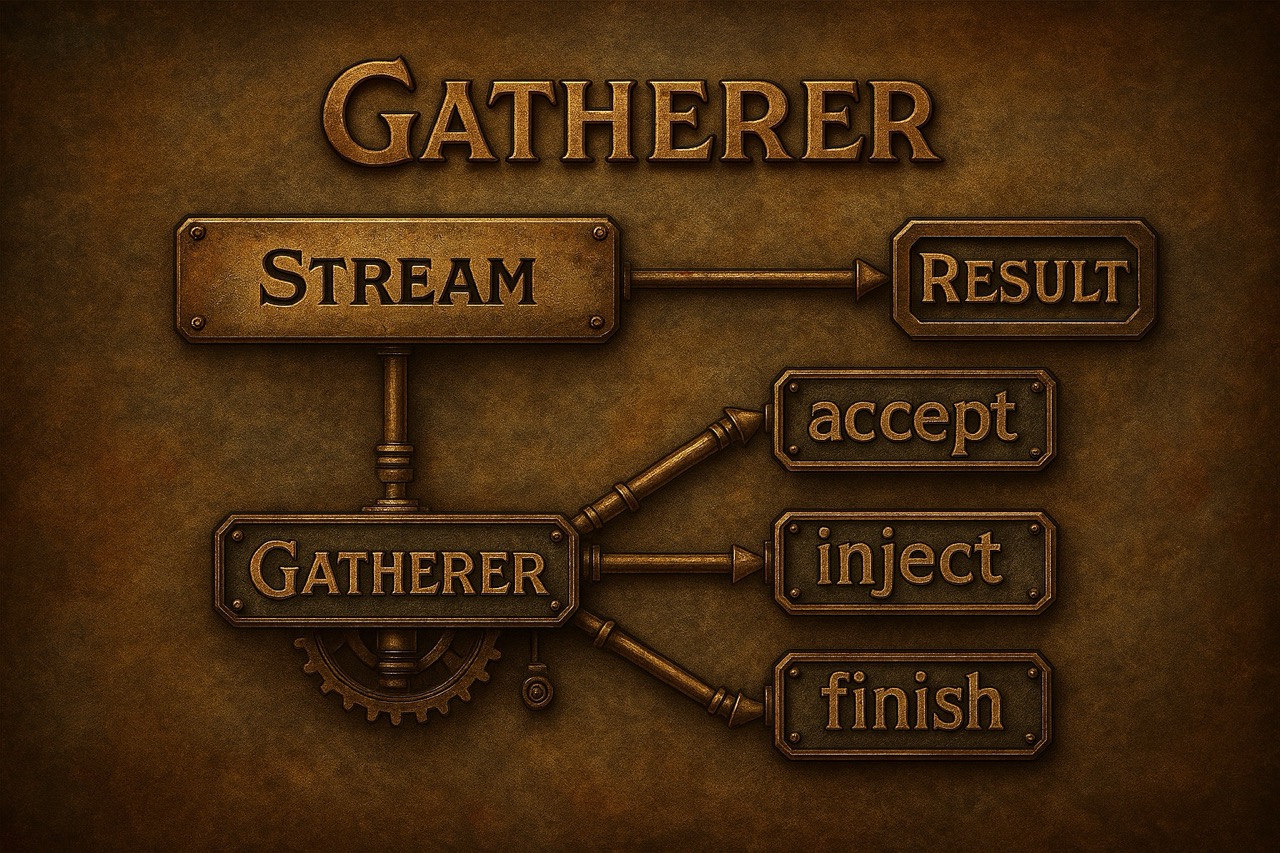
Rethinking Java Streams: Gatherer for more control and parallelism

Since version 8, Java has introduced an elegant, functional approach to processing data sets with the Streams API. The terminal operation collect(…) represents the bridge from the stream to a targeted aggregation - in the form of lists, maps, strings or more complex data structures. Until Java 20 the processing was done Collector-Instances were regulated, which internally consisted of a supplier, an accumulator, a combiner and optionally a finisher. This model works well for simple accumulations but has noticeable limitations, particularly for complex, stateful, or conditional aggregations.

From Java 8 to 24: The evolution of the Streams API

·23 mins
The introduction of the Stream API in Java marked a crucial step in the development of functional programming paradigms within the language. With Java 24, stream processing has been further consolidated and is now a central tool for declarative data processing Stream not about an alternative form of Collection, but rather an abstract concept that describes a potentially infinite sequence of data that is transformed and consumed through a pipeline of operations. While a Collection is a data structure that stores data, Stream is a carrier of a computing model: It does not store any data but instead allows the description of data flows.
2024

TornadoVM - Boosting the Concurrency

TornadoVM is an open-source framework that extends the Java Virtual Machine (JVM) to support hardware accelerators such as Graphics Processing Units (GPUs), Field-Programmable Gate Arrays (FPGAs), and multi-core central processing units (CPUs). This allows developers to accelerate their Java programs on heterogeneous hardware without needing to rewrite their code in low-level languages such as CUDA or OpenCL.

JUnit annotations in focus: The connection between @Test and @Testable

The annotations @Test and @Testable have played an important role in the Java ecosystem regarding application testing. They are essential tools that help developers make unit and automated testing more effective. In this paper, we will explore the differences and connections between @Test and @Testable analyze and the motivation behind the introduction of @Testable understand. We will also play the role of @Testable in developing your test engines and discuss their importance for the flexibility and expandability of tests.

The Risks of Mocking Frameworks: How Too Much Mocking Leads to Unrealistic Tests

·10 mins
Extensive use of mocking frameworks such as Mockito in software development can lead to unrealistic tests. This is because mocking frameworks simulate dependencies of classes or methods in order to test them in isolation. However, when too many mock objects are used, the test often loses touch with reality, which can affect the validity and reliability of the tests. It is important to use mocking carefully to find the right balance between isolated testing and realistic simulation.

What is CWE-1007: Insufficient visual discrimination of homoglyphs for you as a user?

The world of cybersecurity is full of threats, many of which are surprisingly subtle and challenging to detect. One such threat is the problem of so-called homoglyphs. CWE-1007, also known as “Insufficient Visual Distinction of Homoglyphs Presented to User”, is a vulnerability often used by attackers to deceive and compromise your systems or data. In this blog article, you will get a deep insight into CWE-1007, understand its mechanisms, and how to protect yourself from such attacks. We will discuss examples, technical challenges, and best practices that can help you as a developer understand and mitigate this threat.

The History of Parallel Processing in Java: From Threads to Virtual Threads

Since the early days of computer science, parallel processing has represented one of the greatest challenges and opportunities. Since its inception in 1995, Java has undergone a significant journey in the world of parallel programming to provide developers with ever-better tools. This story is a fascinating journey through threads, the executor framework, fork/join, parallel streams, CompletableFuture and the latest developments in Project Loom. In this blog post, we take a detailed look at the evolution of parallel processing in Java and the innovations that came with it.